Thursday, May 9, 2013

Soy and tomato may be effective in preventing prostate cancer

May 8, 2013 ? Tomatoes and soy foods may be more effective in preventing prostate cancer when they are eaten together than when either is eaten alone, said a University of Illinois study.

"In our study, we used mice that were genetically engineered to develop an aggressive form of prostate cancer. Even so, half the animals that had consumed tomato and soy had no cancerous lesions in the prostate at study's end. All mice in the control group -- no soy, no tomato -- developed the disease," said John Erdman, a U of I professor of food science and nutrition.

From the time they were 4 to 18 weeks old, the animals were fed one of four diets: (1) 10 percent whole tomato powder; (2) 2 percent soy germ; (3) tomato powder plus soy germ; and (4) a control group that ate neither tomato nor soy.

The 4- to 18-week time frame modeled an early and lifelong exposure to the bioactive components in these foods, he said.

"Eating tomato, soy, and the combination all significantly reduced prostate cancer incidence. But the combination gave us the best results. Only 45 percent of mice fed both foods developed the disease compared to 61 percent in the tomato group, and 66 percent in the soy group," he said.

Prostate cancer is the most frequently diagnosed cancer in men, but the disease has nearly a 100 percent survival rate if it's caught early. In older men, it is often a slow-growing cancer, and these men often choose watchful waiting over radiation and surgical treatments that have unwelcome side effects, said Krystle Zuniga, co-author of the paper.

Soy isoflavone serum and prostate levels in the mice are similar to those found in Asian men who consume one to two servings of soy daily. In countries where soy is eaten regularly, prostate cancer occurs at significantly lower levels, Erdman noted.

How much soy and tomato should a 55-year-old man concerned about prostate health eat in order to receive these benefits?

"The results of the mouse study suggest that three to four servings of tomato products per week and one to two servings of soy foods daily could protect against prostate cancer," Zuniga said.

According to the scientists, these findings reinforce the recommendation that we should all eat a wide variety of whole fruits and vegetables.

"It's better to eat a whole tomato than to take a lycopene supplement. It's better to drink soy milk than to take soy isoflavones. When you eat whole foods, you expose yourself to the entire array of cancer-fighting, bioactive components in these foods," Erdman said.

The researcher's whole-food recommendation is bolstered by the way soy germ performed in this study. He noted that soy germ has a very different isoflavone profile than the rest of the soybean.

"Of the isoflavones, genistein gets most of the attention. But soy germ is very high in the other isoflavones, daidzein and glycitein, and low in genistein," he said.

It was interesting for the scientists to see that the soy product they used, although low in genistein, was still very effective at reducing cancer incidence.

Source: http://feeds.sciencedaily.com/~r/sciencedaily/health_medicine/nutrition/~3/j2xBda2yelI/130508114307.htm

audacious pollen count mexico city mexico earthquake aziz ansari aziz ansari katherine jenkins

Gene test may help guide prostate cancer treatment

A new genetic test to gauge the aggressiveness of prostate cancer may help tens of thousands of men each year decide whether they need to treat their cancer right away or can safely monitor it.

The new test, which goes on sale Wednesday, joins another one that recently came on the market. Both analyze multiple genes in a biopsy sample and give a score for aggressiveness, similar to tests used now for certain breast and colon cancers.

Doctors say tests like these have the potential to curb a major problem in cancer care ? overtreatment. Prostate tumors usually grow so slowly they will never threaten a man's life, but some prove fatal and there is no reliable way now to tell which ones will. Treatment with surgery, radiation or hormone blockers isn't needed in most cases and can cause impotence or incontinence, yet most men are afraid to skip it.

"We're not giving patients enough information to make their decision," said Dr. Peter Carroll, chairman of urology at the University of California, San Francisco. "You can shop for a toaster" better than for prostate treatment, he said.

A study he led of the newest test ? the Oncotype DX Genomic Prostate Score ? is set for discussion Wednesday at an American Urological Association meeting in San Diego.

The results suggest the test could triple the number of men thought to be at such low risk for aggressive disease that monitoring is a clearly safe option. Conversely, the test also suggested some tumors were more aggressive than doctors had believed.

Independent experts say such a test is desperately needed but that it's unclear how much information this one adds or whether it will be enough to persuade men with low-risk tumors to forgo treatment, and treat it only if it gets worse. Only 10 percent who are candidates for monitoring choose it now.

"The question is, what's the magnitude of difference that would change the patient's mind?" said Dr. Bruce Roth, a cancer specialist at Washington University in St. Louis.

One man may view a 15 percent chance that his tumor is aggressive as low risk "but someone else might say, 'Oh my God, let's set the surgery up tomorrow,'" he said. "I don't think it's a slam dunk."

Also unknown: Will insurers pay for the expensive test without evidence it leads to better care or saves lives?

The newest test was developed by Genomic Health Inc., which has sold a similar one for breast cancer since 2004. Doctors at first were leery of it until studies in more groups of women proved its value, and the same may happen with the prostate test, said Dr. Len Lichtenfeld, the American Cancer Society's deputy chief medical officer.

The company will charge $3,820 for the prostate test and says it can save money by avoiding costlier, unnecessary treatment. Another test for assessing prostate cancer risk that came out last summer ? Prolaris by Myriad Genetics Inc. ? sells for $3,400.

Both companies can sell the tests without Food and Drug Administration approval under separate rules that govern lab diagnostics. Myriad Genetics has published nine studies on Prolaris involving more than 3,000 patients. Genomic Health has not published any results on the prostate test, another thing that makes doctors wary. Yet it has a track record from its breast cancer test.

About 240,000 men in the U.S. are diagnosed with prostate cancer each year, and about half are classified as low risk using current methods. Doctors now base risk estimates on factors such as a man's age and how aggressive cells look from biopsies that give 12 to 14 tissue samples. But tumors often are spread out and vary from one spot to the other.

"Unless you can be sure your biopsy has hit the most aggressive part that's in the prostate, you can't be sure" how accurate your risk estimate is, explained Dr. Eric Klein, chief of urology at the Cleveland Clinic, who led early development of the Oncotype prostate cancer test.

For one study, researchers used prostates removed from 440 men. They measured the activity of hundreds of genes thought to be involved in whether the cancer spread beyond the prostate or proved fatal. A second study of biopsies from 167 patients narrowed it down to 81 genes, and researchers picked 17 that seemed to predict aggressiveness no matter the location in the tumor.

A third study used single needle-biopsy samples from 395 UCSF patients scheduled to have their prostates removed. The gene test accurately predicted the aggressiveness of their cancer once doctors were able to see the whole prostate after surgery.

Using one current method, 37 of the 395 men would have been called very low risk and good candidates for monitoring. Adding the gene test put 100 men into that category, said another study leader, Dr. Matthew Cooperberg of UCSF. The gene test shifted about half of the men into either a lower or a higher risk category.

"It went both ways ? that was the remarkable thing. In any category of risk it added independent information compared to the standard criteria we use today," Carroll said. "More work needs to be done, but, in my opinion, this is a very good start."

However, Dr. Kevin McVary, chairman of urology at Southern Illinois University School of Medicine and a spokesman for the Urological Association, said the test must be validated in more men before it can be widely used.

"It's not there yet," he said.

UCSF just got a federal grant to see how men choose treatments and whether this test might sway them.

"We throw all these numbers at them. Are they really going to make a better decision?" Cooperberg said.

Dean Smith, 60, a retired marketing executive from Mill Valley, Calif., is following his doctor's advice to monitor the cancer he was diagnosed with in March. He said a gene test may have made him more comfortable with that decision.

At least six of his friends suffered side effects ranging from urinary leakage to inability to have sex after having their prostates removed.

"I would suspect that having cancer and having to live with it would be very difficult for them," but it doesn't bother him, Smith said. "I will die from something other than prostate cancer, I guarantee you."

___

Marilynn Marchione can be followed at http://twitter.com/MMarchioneAP

Source: http://news.yahoo.com/gene-test-may-help-guide-prostate-cancer-treatment-041257399.html

nigel barker secret service fenway park philadelphia flyers student loan forgiveness ufc 145 weigh ins record store day 2012

Saturday, April 27, 2013

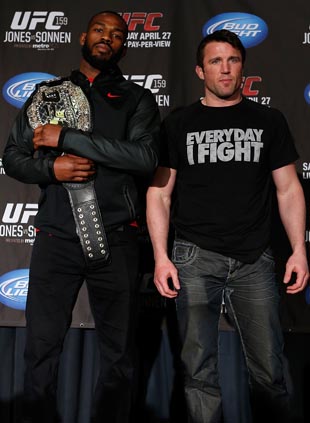
UFC 159 picks from Kevin Iole, Maggie Hendricks and Cagereaders like you

The UFC 159 picks are in. Check out how Kevin Iole and I picked the fights, and who Cagereaders said will win. Thanks to everyone who weighed in on Cagewriter's Facebook page. Want to join in on the fun? Like Cagewriter on Facebook.
Kevin Iole -- Jon Jones TKO2 Chael Sonnen: I've been on a terrible run with my picks in 2013, so my choice might be the thing that helps produce one of the UFC's greatest upsets. But looking closely at the bout, I see no way Sonnen can win it. I expect Jones to get a takedown at some point, cut Sonnen open with an elbow and finish it that way.

Maggie Hendricks -- Jon Jones TKO3 Chael Sonnen: When you cut through the smack talk and look at their actual skills in the cage, Sonnen is moving up in weight to meet a fighter who is younger, faster and more skilled.

Cagereaders -- 68 percent of Cagereaders said Jones would win:
I believe that Jones has more of an arsenal and can keep sonnen guessing as to what is coming next. - Fred Mull
Sonnen never deserves this title shot. Jones by KO in 2nd by GNP elbows, or Sonnen simply quits before getting knocked out when he realizes he has no business in the octagon with Jones. - Chris Dryden

***

Kevin Iole -- Michael Bisping TKO3 Alan Belcher: Both men are inconsistent and both badly need a solid win. I think Bisping gets it by staying on his feet and going back to his kick boxing background.

Maggie Hendricks -- Alan Belcher W3 Michael Bisping: This is a tight fight, but Belcher will take it by bringing the fight to the ground.

Cagereaders -- 50.8 percent of Cagereaders said Bisping will take this bout:
Belcher is more well rounded than Bisping -- Trampas Lee Fleming

***

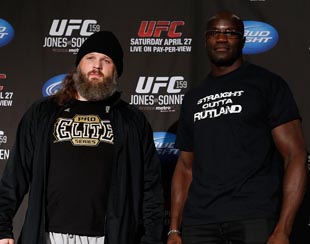
Kevin Iole -- Roy Nelson SUB2 Cheick Kongo: Roy has the power to knock Cheick out. I think he'll hurt him with one of those big windmill right hands he fires and then finish him with a choke.

Maggie Hendricks -- Roy Nelson W3 Cheick Kongo: Nelson has an iron chin, and will be able to withstand Kongo's power.

Cagereaders -- 81 percent of Cagereaders say Nelson will take this fight:
Nelson has a heavy hand and stronger chin than Kongo. -- Pinkie Aman Suarez

***

Kevin Iole -- Phil Davis W3 Vinny Maghalaes: Davis will have to be careful on the ground with Maghalaes, but I believe he's the better overall fighter and that he'll score a convincing decision victory.

Maggie Hendricks -- Phil Davis W3 Vinny Magalhaes: It may not be thrilling, but it will be a wrestling-filled win for Mr. Wonderful.

Cagereaders -- 84 percent of Cagereaders said Davis will take this bout:
Potential submission of the night. Phil is too quick and talented, will submit the submission expert -- Marvin Ishmael

***

Kevin Iole -- Jim Miller W3 Pat Healy: This has the potential to steal the show. It's an excellent bout and I see Miller with a very slight edge.

Maggie Hendricks -- Jim Miller SUB2 Pat Healy: It's been three years since Healy was submitted, but Miller has the skill to do it.

Cagereaders -- 92 percent of you said Miller will win:
Miller had a war against Joe last time out and will come out strong as usual -- Mike Terry

Source: http://sports.yahoo.com/blogs/mma-cagewriter/ufc-159-picks-kevin-iole-maggie-hendricks-cagereaders-144117921.html

pi day Samsung Galaxy S4 St Francis Anquan Boldin Pope Benedict Jesuits percy harvin

Mars Rover Channels Inner 12-Year-Old, Defaces Red Planet

Source: http://www.thehollywoodgossip.com/2013/04/mars-rover-channels-inner-12-year-old-defaces-red-planet/

national weather service weather channel Rivals Kaepernick Eddie Vanderdoes puppy bowl national pancake day

Thursday, April 11, 2013

Syrian militant group vows allegiance to al-Qaida

BEIRUT (AP) ? The leader of a militant group fighting on the side of Syria's rebels has for the first time pledged allegiance to al-Qaida and the terror network's No. 1, Ayman al-Zawahri.

In an audio message Wednesday, Abu Mohammad al-Golani also confirms ties with al-Qaida's Iraq branch but says that he wasn't consulted ahead of an announcement on the two groups' merger.

Al-Qaida's branch in Iraq on Tuesday announced it joined forces with the Syrian group, and that the new union will be called the Islamic State in Iraq and the Levant.

But al-Golani says the announcement was premature and that his Jabhat al-Nusra will continue to use its own name.

His message was first reported by the SITE monitoring service for militant groups.

It's unclear if al-Golani is denying the merger.

Source: http://news.yahoo.com/syrian-militant-group-vows-allegiance-al-qaida-122749712.html

taxes game of thrones season 2 trailer sag award winners girl scout cookies screen actors guild royal rumble results sag awards 2012

Young children have grammar and chimpanzees don't

Apr. 10, 2013 ? A new study from the University of Pennsylvania has shown that children as young as 2 understand basic grammar rules when they first learn to speak and are not simply imitating adults.

The study also applied the same statistical analysis on data from one of the most famous animal language-acquisition experiments -- Project Nim -- and showed that Nim Chimpsky, a chimpanzee who was taught sign language over the course of many years, never grasped rules like those in a 2-year-old's grammar.

The study was conducted by Charles Yang, a professor of linguistics in the School of Arts and Sciences and of computer science in the School of Engineering and Applied Science. It was published in the Proceedings of the National Academy of Sciences.

Linguists have long debated whether young children actually understand the grammar they are using or are simply memorizing and imitating adults. One of the difficulties in resolving this debate is the inherent limitations of the data; 2-year-old children have very small vocabularies and thus don't provide many different examples of grammar usage.

"While a child may not say very much, that doesn't mean that they don't know anything about language," Yang said, "Despite the superficial lack of diversity of speech patterns, if you study it carefully and formulate what having a grammar would entail within those limitations, even young children seem very much on target."

Yang's approach was to look at one area of grammar that young children do regularly display: article usage, or whether to put "a" or "the" before a noun. He found a sufficient number of examples of article usage in the nine data sets of child speech he analyzed, but there was another challenge in determining if these children understood the grammar rules they were using.

"When children use articles, they're pretty much error free from day one," Yang said. "But being error free could mean that they've learned the grammar of article usage in English, or they have memorized and are imitating adults who wouldn't make mistakes either."

To get around this problem, Yang took advantage of the fact that most nouns can be paired with either the definite or indefinite article to produce a grammatically correct phrase, but the resulting phrases have different meanings and usages. This makes the combinations vary in frequency.

For example, "the bathroom" is a more common phrase than "a bathroom," while "a bath" is more common than "the bath." This difference has nothing to do with grammar but rather the frequency with which phrases containing those combinations are used. There are simply more opportunities to use phrases like "I need to go to the bathroom" or "the dog needs a bath" than there are phrases like "there's a bathroom on the second floor" or "the bath was too cold."

This means that the likelihood of using a particular article with a given noun is not 50/50; it is weighted toward either "the" or "a." Such lopsided combination tendencies can be characterized by general statistical laws of language, which Yang used to develop a mathematical model for predicting the expected diversity of noun phrases in a sample of speech.

This model was able to differentiate between the expected diversity if children were using grammar, as compared to if they were simply imitating adults. Due to the differences of these frequencies, an adult might only say "the bathroom" -- never saying "a bathroom" -- to a child, but that child would still be able to say "a bathroom" if he or she understood the underlying grammar.

"When you compare what children should say if they follow grammar against what children do say, you find it to almost indistinguishable," Yang said. "If you simulate the expected diversity when a child is only repeating what adults say, it produces a diversity much lower than what children actually say."

As a comparison, Yang applied the same predictive models to the set of Nim Chimpsky's signed phrases, the only data set of spontaneous animal language usage publicly available. He found further evidence for what many scientists, including Nim's own trainers, have contended about Nim: that the sequences of signs Nim put together did not follow from rules like those in human language.

Nim's signs show significantly lower diversity than what is expected under a systematic grammar and were similar to the level expected with memorization.

This suggests that true language learning is -- so far -- a uniquely human trait, and that it is present very early in development.

"The idea that children are only imitating adults' language is very intuitive, so it's seen a revival over the last few years," Yang said. "But this is strong statistical evidence in favor of the idea that children actually know a lot about abstract grammar from an early age."

Share this story on Facebook, Twitter, and Google:

Other social bookmarking and sharing tools:


Story Source:

The above story is reprinted from materials provided by University of Pennsylvania.

Note: Materials may be edited for content and length. For further information, please contact the source cited above.


Journal Reference:

  1. C. Yang. Ontogeny and phylogeny of language. Proceedings of the National Academy of Sciences, 2013; DOI: 10.1073/pnas.1216803110

Note: If no author is given, the source is cited instead.

Disclaimer: This article is not intended to provide medical advice, diagnosis or treatment. Views expressed here do not necessarily reflect those of ScienceDaily or its staff.

Source: http://feeds.sciencedaily.com/~r/sciencedaily/top_news/top_science/~3/Ked33y6puUA/130410131327.htm

jeremy lin Sage Stallone Mermaid Body Found Celeste Holm Stephen Covey klimt bastille day

93% Zero Dark Thirty

All Critics (244) | Top Critics (45) | Fresh (229) | Rotten (17) | DVD (2)

What's striking is the absence of triumphalism -- Bigelow doesn't shy away from showing the victims shot down in cold blood in the compound -- and we come away with the overwhelming sense that this has been a grim, dark episode in our history.

This is an instant classic.

Chastain makes Maya as vivid as a bloodshot eye. Her porcelain skin, delicate features and feminine attire belie the steel within.

No doubt Zero Dark Thirty serves a function by airing America's dirty laundry about detainee and torture programs, but in its wake, there's a crying need for a compassionate Coming Home to counter its brutal Deer Hunter.

While "Zero Dark Thirty" may offer political and moral arguing points aplenty, as well as vicarious thrills,as a film it's simply too much of a passable thing.

From the very first scenes of Zero Dark Thirty, director Kathryn Bigelow demonstrates why she is such a formidable filmmaker, as adept with human emotion as with visceral, pulse-quickening action.

A film of infectious urgency, questionable accuracy, murky morality and undeniable emotional and intellectual power

Kathryn Bigelow's Zero Dark Thirty is a grueling masterpiece that captures the hunt for bin Laden with a daunting amount of realism and efficiency.

Slathered in controversy, Kathryn Bigelow's Zero Dark Thirty confidently and forcefully storms onto DVD with an admirable A/V transfer, only hindered by a paltry gathering of extras from Sony.

The direction by Kathryn Bigelow, who won Oscars for Best Film and Best Director in her previous film "The Hurt Locker," is fierce and focused...

Despite what those silly Oscars would have you believe, it was this movie, not Argo, that was the finest of 2012.

Indulges Cheneyian fantasies complete with the bad-movie scene of the prisoner's defiance: "You're just a garbage man in the corporation," shouts the Arab who needs a lesson in manners from the Ph.D. (in torture?) who is racking him.

Bigelow tells the story very well, very efficiently, but doesn't really say much about it, which is ironic given the response to the film in some quarters.

Kathryn Bigelow takes the procedural model and brushes away every unnecessary detail, leaving behind a heavy, blunt object of a film that is also hugely watchable, engrossing and, best of all... highly suspenseful.

Rotten Tomatoes notes that I agree with Tomatometer critics 80 percent of the time, but this is one of those times I have to part ways with them.

Bigelow has directed excellent movies before, but this deserves to be remembered as the film that established her as a master.

You can't deny that what Zero Dark Thirty sets out to do, it does excellently.

An exhilarating and compelling historical document worthy of praise.

Bigelow's latest proves a rewarding piece of filmmaking, one that, in its best moments at least, is as gripping and as troubling as anything the director's ever made.

Bigelow and screenwriter Mark Boal shape history -- those breaks, big and small, that led to the killing of Osama bin Laden -- into one of the finest fact-based thrillers since "All the President's Men."

Purely as cinematic exercise, Zero Dark Thirty is an exhilarating piece of work. But, beyond its for-the-times subject matter, the work does not linger whatsoever.

Zero Dark Thirty is interesting as opposed to enjoyable, intriguing as opposed to entertaining, and certainly less memorable than The Hurt Locker.

It's quite remarkable how Bigelow and Boal managed to take 12 years of information (including a conclusion that everyone knows) and packaged it into a coherent, intimate and intense movie.

We know the ending, yet remain mesmerized by familiar details, filmed with a harrowing sense of urgency. It's as close to being in the White House situation room that night, watching a closed-circuit broadcast, as anyone could expect.

The second half of the film IS the film.

Source: http://www.rottentomatoes.com/m/zero_dark_thirty/

josh harvey clemons college football recruiting rankings ground hog day 2012 aaron carter black history month did groundhog see his shadow soul train don cornelius